







FIBC Types A, B, C and D: Earthing and Static Grounding Requirements
A practical guide to how Type A, Type B, Type C and Type D FIBCs control electrostatic charge, and what each type requires for safe use in bulk handling operations.
FIBC static grounding requirements: the short answer
FIBC Types A, B, C and D control static electricity differently. Type C FIBCs must be grounded during filling and emptying. Type D FIBCs do not require a direct bag ground, while Type A and Type B FIBCs have restricted or unsuitable hazardous area use.
- Use the correct FIBC type for the hazard. Bag selection should be based on material MIE, hazardous area classification and site risk assessment.
- Ground Type C FIBCs directly. Connect the bag to a verified earth/ground point and maintain a reliable path during transfer.
- Control the wider electrostatic risk. Nearby conductive items, contaminated bag surfaces and operator procedures all affect safe use.
What are the four FIBC types?
Flexible intermediate bulk containers (FIBCs) are divided into four groups: A, B, C, and D.
Quick comparison: FIBC type vs earthing requirement
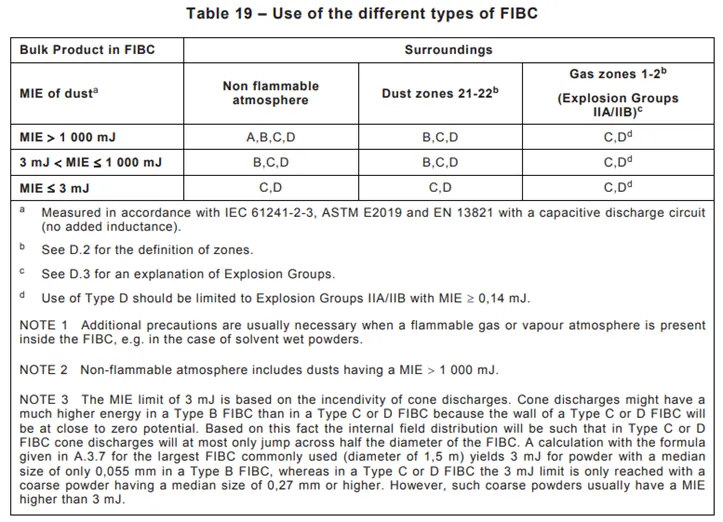
The use of these different types of FIBC is set out in the international guidance document IEC TS 60079-32-1:
For more detailed technical background, read Newson Gale’s whitepaper on the theory and practice of controlling static electricity in FIBC operations.
While this may seem complicated at first glance, safe electrostatic earthing procedures for each type of bag can be defined and applied consistently to their use in hazardous area operations.
Type A FIBC: non-conductive bags for non-flammable environments
Type A FIBCs are simple containers made of polypropylene or other flexible, non-conductive fabric.
Due to their non-conductive construction and lack of any means to provide effective electrostatic earthing, Type A FIBCs are not suitable for hazardous area operations.
They should only be used in non-flammable atmospheres with materials that have a minimum ignition energy, or MIE, of greater than 1,000 mJ.
Type B FIBC: low breakdown voltage bags with limited hazardous area use
Type B FIBCs are of similar construction to Type A bags, but are made from flexible materials that have a low breakdown voltage to help prevent propagating brush discharges.
When electrostatic charge builds up on the bag and its contents, the goal is to allow it to discharge in small, frequent static shocks with low energies, rather than build up into one larger discharge that could ignite the materials being handled or the flammable atmosphere they have created.
Beyond this, Type B FIBCs have no designated mechanism to safely dissipate electrostatic charge.
This can work for some materials with higher minimum ignition energies and in some hazardous area zones, but Type B containers are not suitable for lower-MIE materials or certain hazardous area zones.

Image source and licence details: Tesla-coil-discharge.jpg by Iantresman / Caroline Tresman, via Wikimedia Commons. Licensed under CC BY 2.5, CC BY-SA 3.0, and GFDL. No changes made.
Type C FIBC: conductive bags that must be connected to earth
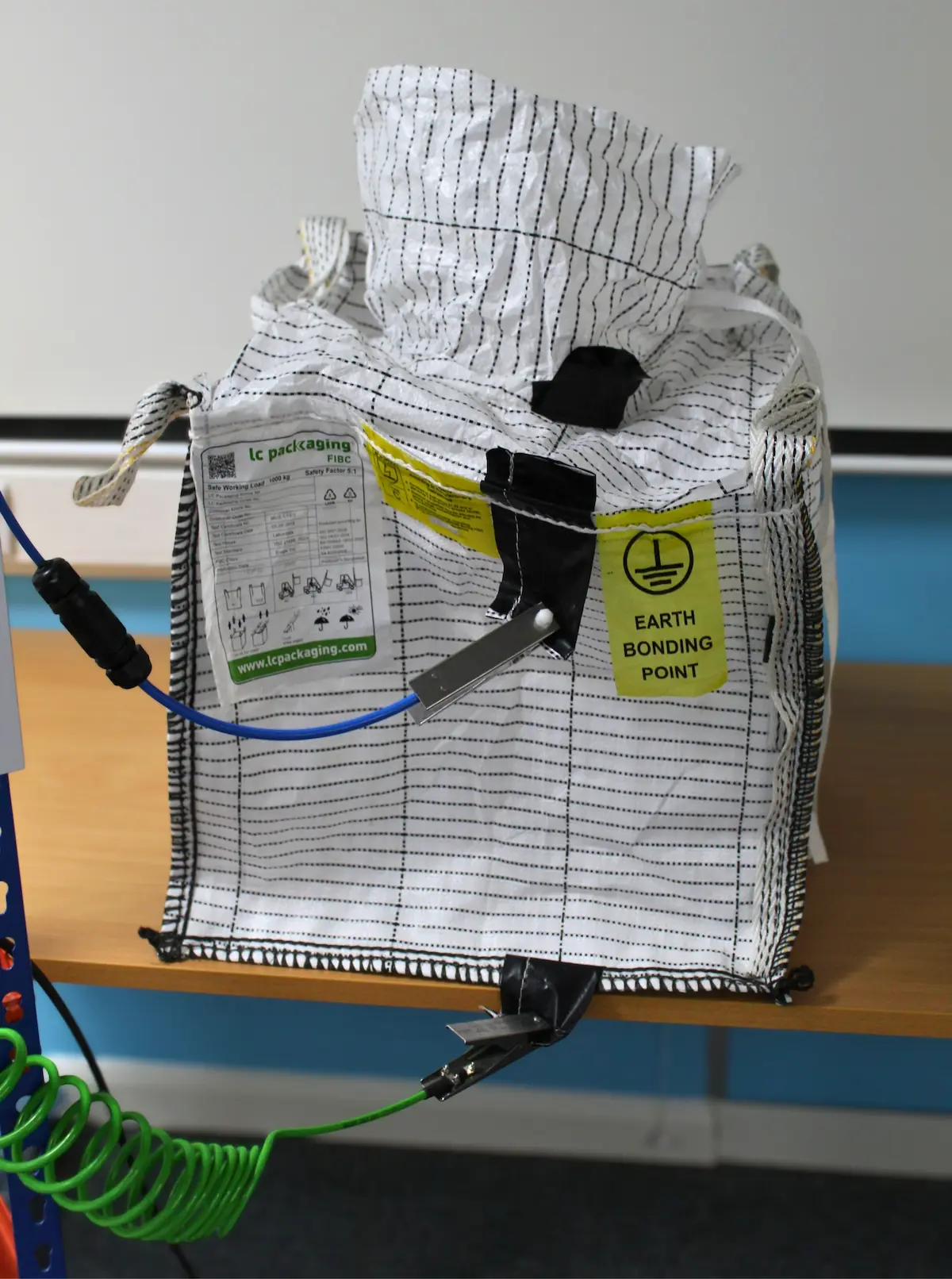
Type C FIBCs are constructed from flexible materials interwoven with conducting threads designed to allow the bag to safely dissipate electrostatic charge when connected to an earthing point.
The nature of this connection to earth is defined by standards and industry best practice:
IEC TS 60079-32-1 states that Type C FIBCs are designed to be connected to earth during filling and emptying operations.
IEC 61340-4-4 and NFPA 77 state that a reliable connection to earth must be in place, with a maximum resistance level of 1 x 10⁸ Ω.
This connection is best achieved via a clamp attached to one of the designated earthing tabs built into the FIBC, connecting the bag to a local verified earthing point on site.
Passive vs active FIBC earthing systems
The connection can take the form of a passive earthing solution or an active earthing solution. Passive systems must be manually confirmed by an operator, while active systems add the benefits of continuous monitoring, visual indication via LED displays, and automation of functions such as an automatic shutoff in the event of unsafe conditions through interlocks to process equipment.
An active earthing solution that is well designed in line with the resistance values put forward by the relevant standards and guidance documents also confirms conformance to requirements of the standards and best practice detailed above.
Type C FIBCs are specifically designed for hazardous area operation and must have a suitable connection to earth before and during all hazardous area bulk material transfer operations. In addition, IEC TS 60079-32-1 also recommends that all conductive items within 1m of any FIBC used in hazardous area operations should be properly earthed. These earthing provisions can take the form of permanent, semi-permanent, or removable connections, separate to the earthing solution for the FIBC itself, and can be passive or active.
Type D FIBC: static dissipative bags that do not need direct earthing
Type D FIBCs are constructed from static dissipative material and work on the principle of safely allowing electrostatic charge to dissipate via low-energy corona discharge.
This means that the bag itself does not need its own earthing connection.
Operators should still ensure safe conditions for electrostatic charge dissipation via corona discharge. This includes making sure that the surface of a Type D FIBC does not become contaminated with conductive or flammable materials such as grease before or during operation.
Why conductive items near FIBCs also need earthing
As with Type C or any other FIBCs used in hazardous area operations, any conductive item within a 1m radius of the FIBC when in operation must have its own reliable connection to earth.
FIBC earthing requirements summary table
| FIBC type | Electrostatic earthing requirement | Practical safety measures |
|---|---|---|
| Type A | N/A — No safe electrostatic earthing route. | Not suitable for hazardous area operations. Use only in non-flammable atmospheres and appropriate material conditions. |
| Type B | N/A — No mechanism for dissipating electrostatic charge. | Only suitable for some materials and some hazardous areas, subject to risk assessment. |
| Type C | Direct earth connection required. | Direct connection to a local site earthing point with maximum resistance level of 1 x 10⁸ Ω. |
| Type D | No direct earthing connection for bag. | Charge dissipation occurs via corona discharge into the surrounding atmosphere. |
Which FIBC type is best for hazardous area operations?
When undertaking hazardous area bulk material transfer operations, it is vital to use the appropriate equipment for safe operational procedures.
In practical terms, this means using Type B FIBCs only in certain and limited hazardous area operations when deemed suitable, and using Type C or Type D FIBCs, each with the appropriate electrostatic control measures in place, more generally for hazardous areas.
For Type C FIBCs, this means establishing and maintaining a direct connection between the bag and a local earthing point. For Type D FIBCs, it means ensuring safe conditions for corona discharge and controlling nearby conductive items.
Need help applying FIBC earthing requirements?
Explore practical static grounding guidance or speak to Newson Gale about selecting the right FIBC earthing solution for your application.