


Specification of hazardous area certified equipment
Hazardous Area Equipment
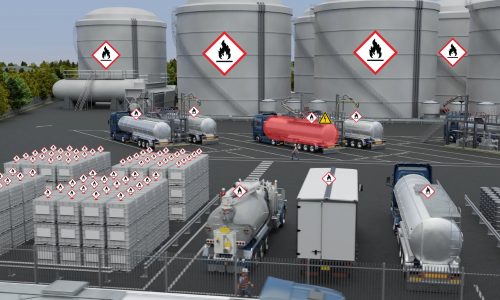
When specifying equipment intended for use in a potentially explosive atmosphere (Ex atmosphere), it is important to determine what the hazardous area classification of the location is prior to engaging in the search. This is so that equipment with the appropriate level of Ex certification can be selected for installation, regular maintenance, and safe operation over its service lifetime.
As it is not possible to provide an in-depth review of the clauses in the standards referenced below, only certain aspects will be highlighted.
If you have any doubts about your obligations as a specifier, installer, inspector, or maintainer of Ex-certified equipment, please discuss them with a competent person or authority.
As the sole manufacturer and Ex certificate holder of Newson Gale hazardous area certified static earthing equipment, our team of CompEx-certified engineers can support customers with any detailed questions they may have with respect to the Ex certification of our static earthing systems, associated Instruction Manuals, and the hazardous areas in which the Ex equipment can be installed and used.

Standards referenced:
- BS EN/IEC 60079-14 “Explosive atmospheres – Electrical installations design, selection and erection”
- BS EN ISO/IEC 80079-20-1 “Explosive atmospheres – Material characteristics for gas and vapour calculation. Test methods and data”
- BS EN ISO/IEC 80079-20-2 “Explosive atmospheres – Material characteristics. Combustible dusts test methods”
- BS EN/IEC 60079-10-1 “Explosive atmospheres – Classification of areas – Explosive gas atmospheres”
- BS EN/IEC 60079-10-2 “Explosive atmospheres – Classification of areas – Explosive dust atmospheres”
- BS EN/IEC 60079-7 “Explosive atmospheres – Equipment protection by increased safety “e”
- BS EN/IEC 60079-11 “Explosive atmospheres – Equipment protection by intrinsic safety “i”
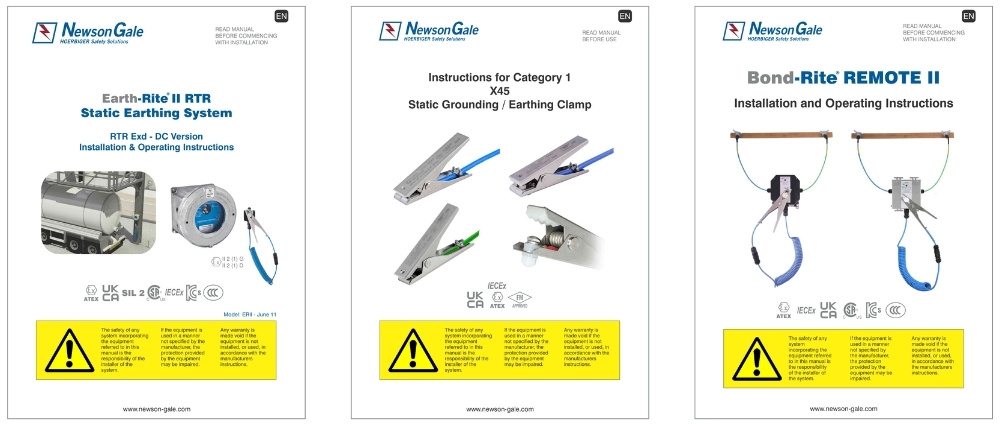
All our products comes with a manufacturer’s Instruction Manual
Selection of Ex equipment
- The classification of the hazardous area and the associated EPLs*.
- The classification of the gas, vapour or dust group and subgroups.
- The temperature class or ignition temperature of the gas or vapour.
- The Minimum Ignition Temperature (MIT) of the dust cloud and MIT of the dust layer.
- The intended application of the equipment.
- The ambient temperature range and potential external influences.
*EPLs: Equipment Protection Levels
Competency of individuals
It should be borne in mind that persons tasked with designing, selecting, and erecting Ex equipment should be competent in these activities. Annex A.2.1 of BS EN/IEC 60079-14 states that persons engaged in such activities should possess:
- General understanding of relevant electrical engineering.
- Understanding and ability to read and assess engineering drawings.
- Practical understanding of explosion protection principles and techniques.
- Working knowledge and understanding of the relevant standards in explosion protection.
- Basic knowledge of quality assurance, including the principles of auditing, documentation, traceability of measurement, and instrument calibration.
More specific competencies are described depending on people’s roles. For example, the competencies of persons designing installations and selecting the Ex equipment to operate in such installations are different from those who may be operating the Ex equipment or providing inspection or maintenance services.
Annex A.3.2 “Responsible persons” states:
“Responsible persons shall be able to demonstrate their competency and provide evidence of attaining the knowledge and skill requirements specified in A.2.1 relevant to the types of protection and/or types of equipment involved”.
More detailed requirements for specific roles are outlined in the rest of this Annex.
If you choose to specify a Newson Gale static control solution, regardless of where you are in the world, our sales team/s and CompEx® Engineers will support you with any pre-sales or post-sales queries you may have, ranging from the Ex-certification details of our products, support with installation and operating instructions, and any technical post-installation questions you may have.

Documentation
The installation of Ex equipment must comply with the manufacturer’s equipment certificate and documentation. This information is usually provided in the manufacturer’s Instruction Manual. In accordance with Clause 4.2 of BS EN/IEC 60079-14, a “verification dossier” needs to be kept for each installation.
The verification dossier should contain the following information. (Please note that the following list is non-exhaustive and only applies to certain clauses in the standard.)
For the site:
- Area classification documents (see IEC 60079-10-1 and IEC 60079-10-2) with plans showing the classification and extent of the hazardous areas, including the zoning (and maximum permissible dust layer thickness if the hazard is due to dust);
- Optional assessment of consequences of ignition (see 5.3*);
- Where applicable, gas, vapour, or dust classification in relation to the group or subgroup of the electrical equipment;
- Temperature class or ignition temperature of the gas or vapour involved;
- Where applicable, the material characteristics including electrical resistivity, the minimum ignition temperature of the dust cloud, the minimum ignition temperature of the dust layer, and the minimum ignition energy of the dust cloud;
- External influences and ambient temperature.
Note: *5.3 references the EPLs for specific zones as described in Tables 1 and Table 2 below.
For the Ex equipment:
- Manufacturer’s instructions for selection, installation, and initial inspection;
- Documents for electrical equipment with conditions of use, e.g., for equipment with certificate numbers that have the suffix “X”;
- Descriptive system document for the intrinsically safe system (see 16.2.4.2);
- Details of any relevant calculation, e.g., for purging rates for instruments or analyser houses;
- Manufacturer’s/qualified person’s declaration (see 4.4.2).
Material groups and equivalent equipment markings
Hazardous areas should be classified into groups and zones. This enables the specification of Ex-certified equipment that matches the Equipment Protection Levels (EPLs) required for the zoning of the area in which that material is likely to produce an explosive atmosphere.
In accordance with BS EN ISO/IEC 80079-20-1 “Material characteristics for gas and vapour calculation – Test methods and data”, gas and vapour atmospheres are defined as Group II materials that are subdivided in relation to their maximum experimental safe gap (MESG) and auto ignition temperature (AIT) characteristics. These subdivisions are defined as (including examples):
- IIA (butane, heptane, ethyl acetate)
- IIB (ethylene, ethanol, dibutyl ether)
- IIC (hydrogen, acetylene, carbon disulphide)
Electrical equipment intended for use in explosive gas and vapour atmospheres is classed as Group II. Equipment marked:
- IIA can only be used in IIA gas/vapour atmospheres
- IIB can only be used in IIA and IIB gas/vapour atmospheres
- IIC can be used in all gas/vapour atmospheres
Based on BS EN ISO/IEC 80079-20-2 “Material characteristics – Combustible dusts test methods”, combustible dust materials are categorised as Group III and subdivided into:
- IIIA: combustible flying
- IIIB: non-conductive dust
- IIIC: conductive dust
Electrical equipment intended for use in explosive dust atmospheres is classed as Group III. Equipment marked with:
- IIIA can only be used in IIIA atmospheres
- IIIB can be used in IIIB and IIIA dust atmospheres
- IIIC can be used in any dust atmosphere
Group I equipment is intended for use in mining and, as such, is not relevant to Newson Gale’s customers.
Hazardous area zoning and associated Equipment Protection Levels (EPLs)
Hazardous area zones are classified based on the following standards, which define the methods by which the type and extent of the zones can be established for a particular location.
- BS EN IEC 60079-10-1 “Classification of areas – Explosive gas atmospheres”
- BS EN IEC 60079-10-2 “Classification of areas – Explosive dust atmospheres”
Areas of the plant where explosive atmospheres are not expected to form or be present are classified as “non-hazardous”.
The EPLs of Ex equipment operating in explosive atmospheres are described in EN IEC 60079-0 “Equipment – General requirements”. This standard “specifies the general requirements for construction, testing and marking of Ex Equipment and Ex Components intended for use in explosive atmospheres”.
Different types of protection are designed to meet the EPLs of specific zones. The levels of protection are based on preventing ignition of the surrounding atmosphere due to the likelihood of the equipment becoming an ignition source. Subparts of the EN IEC 60079-0 standard provide the detailed requirements for each specific type of protection. For example, protection by intrinsic safety, a method that limits the energy of electrical circuits, thereby reducing the potential for sparking or heating to ignite an explosive atmosphere, is detailed in BS EN IEC 60079-11 “Equipment protection by intrinsic safety “i”.
Gas/Vapour Zones are defined as:
| Zone Classification | Definition in BS EN / IEC 60079-14 | Equipment Protection Levels | Protection by intrinsic safety |
| Zone 0 | Place in which an explosive atmosphere consisting of a mixture with air of flammable substances in the form of a gas or vapour is present continuously or for long periods or frequently. | “Ga” | “ia” |
| Zone 1 | Place in which an explosive atmosphere consisting of a mixture with air of flammable substances in the form of gas or vapour is likely to occur in normal operation occasionally. | “Ga” or “Gb” | “ia” or “ib” |
| Zone 2 | Place in which an explosive atmosphere consisting of a mixture with air of flammable substances in the form of gas or vapour is not likely to occur in normal operation but, if it does occur, will persist for a short period only. | “Ga” or “Gb” or “Gc” | “ia” or “ib” or “ic” |
Dust Zones are defined as:
| Zone Classification | Definition in EN IEC 60079-14:2021 | Equipment Protection Levels | Protection by enclosure |
| Zone 20 | Area in which an explosive atmosphere in the form of a cloud of dust in air is present continuously, or for long periods or frequently. | “Da” | “ta” |
| Zone 21 | Area in which an explosive atmosphere in the form of a cloud of dust in air is likely to occur, occasionally, in normal operation. | “Da” or “Db” | “ta” or “tb” |
| Zone 22 | Area in which an explosive atmosphere in the form of a cloud of dust in air is not likely to occur in normal operation but, if it does occur, will persist for a short period only. | “Da” or “Db” or “Dc” | “ta” or “tb” or “tc” |
Combinations of protection concepts
The techniques described in IEC 60079 can be combined to achieve a desired set of outcomes. This combination of techniques must be assessed as a single system described as “Ex Equipment”. Assuming the product passes the necessary set of design and testing standards carried out by a notified body (for ATEX) and/or an ExCB (for IECEx), the products will be marked with the details that enable the specifier to match the product with appropriate hazardous area classification details.
Examples:

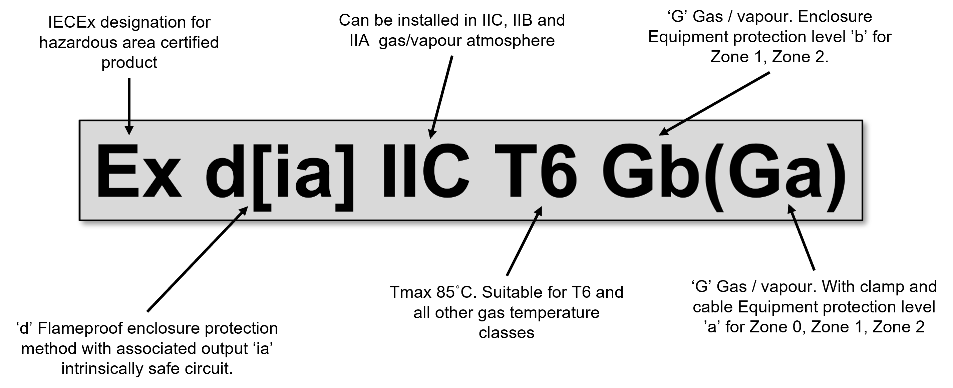

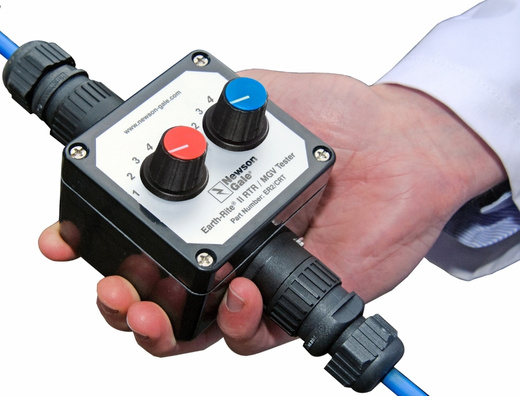
Earth-Rite® systems, such as the RTR road tanker earthing system, do not require calibration during their lifetime. However, operator parameters can be tested to verify performance.
Is one equipment protection concept better than another?
Although harmonised standards are designed to promote compliance with the Essential Health & Safety Requirements (EHSRs) of the relevant legislation, some Ex equipment manufacturers claim that systems which combine different protection concepts can possess certain technical advantages over other manufacturers’ equipment.
Examples:
- Some installers believe that Ex(d) flameproof enclosures take a long time to install because they need to be fitted with compound-filled/ barrierised glands*. This is not the case when the Ex(d) flameproof enclosures’ internal volume is less than two litres. In such cases, non-compound-filled/barrierised Ex(d) glands can be used in IIA and IIB atmospheres. The majority of Newson Gale’s range of Ex(d) enclosures are less than 2 litres internal capacity, hence standard Ex(d) glands can be used in IIA, IIB, and all dust group atmospheres.
- Some manufacturers promote the idea that using a protection concept quartz quartz-filled or encapsulation, has the added benefit of protecting PCB components from electronic damage caused by personnel discharging static from their body during installation. To begin with, any installer competent enough to work in an Ex area should be wearing static dissipative shoes to prevent their bodies providing a potential source of ignition through a static spark discharge. Newson Gale provides protective ESD bags where PCBs can be held until required for installation. A potential disadvantage of compound filling is inaccessibility to the PCB if there is a need to repair or replace the PCB or components on the PCB that are covered by the hardened compound. In such cases, the whole system may need to be scrapped.
- Where a concept like intrinsic safety (BS EN IEC 60079-11) is combined with increased safety (BS EN IEC 60079-7), it is possible to perform live maintenance on the Ex equipment for a “short period”, provided the manufacturer’s instructions permit it. Live maintenance would suggest that the enclosure can be opened in a classified area; however, the “short period” of time is not defined in the relevant clause (4.10.3) of the increased safety standard. This could be a useful feature for maintenance staff if, for example, the Ex equipment requires immediate attention, but this feature should not be a substitute for systems that require regular attention to rectify reliability or performance issues. Aside from the risk attached to the contents of the enclosure being exposed to a classified area for an undefined period of time, protection from electric shock due to the presence of live non-intrinsically safe circuits is also a factor that needs to be addressed.
* When installed in accordance with EN IEC 60079-14, compound-filled/barrier cable glands may not be required.
Hybrid atmospheres
Although rare, if hybrid atmospheres do exist in a process area, special assistance should be sought. The presence of dust in a gas/vapour atmosphere can have the effect of altering characteristics, e.g., lowering the MIT of the dust cloud.
“While the essential legal requirements in GB remain the same as the equivalent EU law, the informative Annex ZA/ZZ and any references to EU law in designated standards should be read as applying to the legislation for GB in the same way, subject to any restrictions or points made in the relevant notice of publication. This will change if and when the essential requirements in GB change. We have asked BSI to ensure that any new or revised designated standards map across to the essential requirements in GB.”
www.gov.uk/guidance/designated-standards#electric-and-electronic-engineering
Note on ATEX / IECEx / UKCA standards
The similarities and differences between ATEX, IECEx, and, following the UK’s withdrawal from the EU, UKCA, can be confusing.
CENELEC is the body that publishes EN standards that meet the Essential Health & Safety Requirements (EHSRs) mandated by the European Commission in the field of electrical technology. In the interests of driving common standards, CENELEC works closely with the International Electrotechnical Commission (IEC) and the International Standards Organization (ISO).
In the area of Ex equipment standardisation, the IEC, on request from CENELEC, writes the standards that are deemed to meet the EHSRs of the ATEX equipment Directive 2014/34/eu. As such, they get designated with the IEC description, e.g., IEC 60079-0 “Equipment – General requirements” when they are published by the IEC. When CENELEC publishes them as European Normative standards, they are normally listed with EN in front of IEC, e.g., EN IEC 60079-0. The IEC runs its own Ex equipment certification scheme through IECEx. IECEx is a compulsory Ex certification requirement for some countries, e.g., Australia.
Since the UK left the EU, direction still needs to be provided on how the standards will be designated. The standards referenced still meet current DSEAR requirements. As this situation is subject to change, please consult the relevant authorities for the most current information. Also, take a look at the level of control.
Latest UK Government information (April 2023).