

Static Earthing Solution for Type C FIBC Bags
Flexible Intermediate Bulk Containers (FIBC) are regularly used to store and transport products like powders, flaked and granular materials. In EX environments, due consideration needs to be given to their use as the movement of such materials into and out of FIBCs can produce electrostatic currents and voltages of magnitudes that are well above the Minimum Ignition Energies (MIEs) of combustible dusts and vapours.
A product standard published by the IEC, and adopted by CEN (for EN standards publication purposes), addresses the requirements of FIBC used in EX atmospheres that range in volume from 0.25 m3 to 3 m3.
This standard is called: BS EN IEC 61340-4-4 “Electrostatics Part 4-4: Standard test methods for specific applications – Electrostatic classification of flexible intermediate bulk containers (FIBC)”. As it is not possible to explore the detailed requirements of this standard in depth here, it is advisable to review a copy of the standard if you are using or intend to use FIBC in an EX atmosphere.
Recommended Solution:
A Summary of the BS EN IEC 61340-4-4 Requirements:
- Classification and labelling of FIBC
- Classification of inner liners
- Specification of test methods for each type of FIBC, inner liner, labels and document pockets
- Design and performance requirements for FIBC, inner liners, labels and document pockets
- Safe use of FIBC (including those with inner liners) within different zones defined for explosion endangered environments, described for areas where combustible dusts are, or can be, present (IEC 60079-10-2), and for explosive gas atmospheres (IEC 60079-10-1)
- Procedures for type qualification and certification of FIBC, including the safe use of inner liners
- Depending on their construction, the bags are classed as:
- Type A
- Type B
- Type C
- Type D
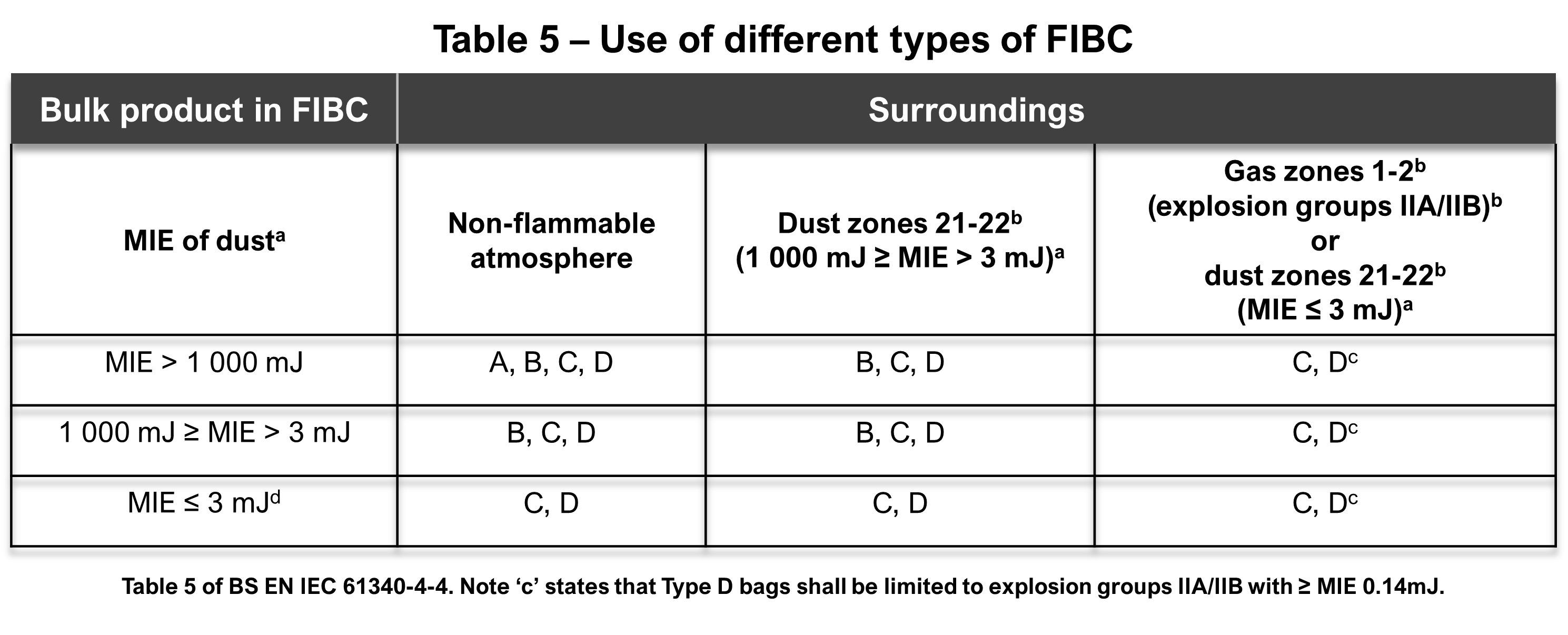
Restrictions around the usage of different bag types in Ex atmospheres is summarised in Table 5 of Clause 5, “Safe use of FIBC”
FIBC Type C Bags
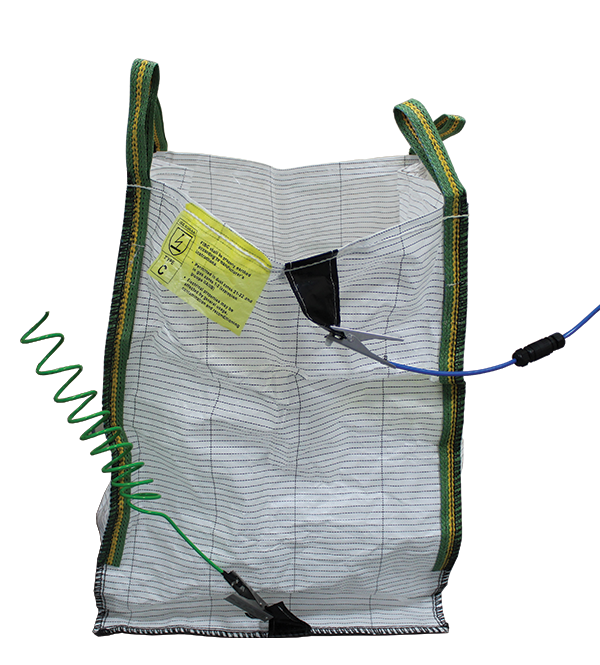
FIBC Type C bags, along with any inner liners incorporated into their construction, are designed to be earthed. This enables the dissipation of electrostatic charge from the bag so that incendive discharges from the bag are mitigated. Type D bags are different to Type C bags in that they are constructed of a specific material that is designed to prevent incendive electrostatic discharges, hence do not require earthing. Additional specific requirements regarding the use of Type D bags are described in the standard.
Clause 4.1.4 of BS EN IEC 61340-4-4 defines Type C bags as:
“Type C FIBC are made from conductive fabric or plastic sheet, or interwoven with conductive threads or filaments and designed to prevent the occurrence of incendiary sparks, brush discharges and propagating brush discharges. Type C FIBC are designed to be connected to earth before the commencement of filling and emptying operations and remain connected to earth during these operations.”
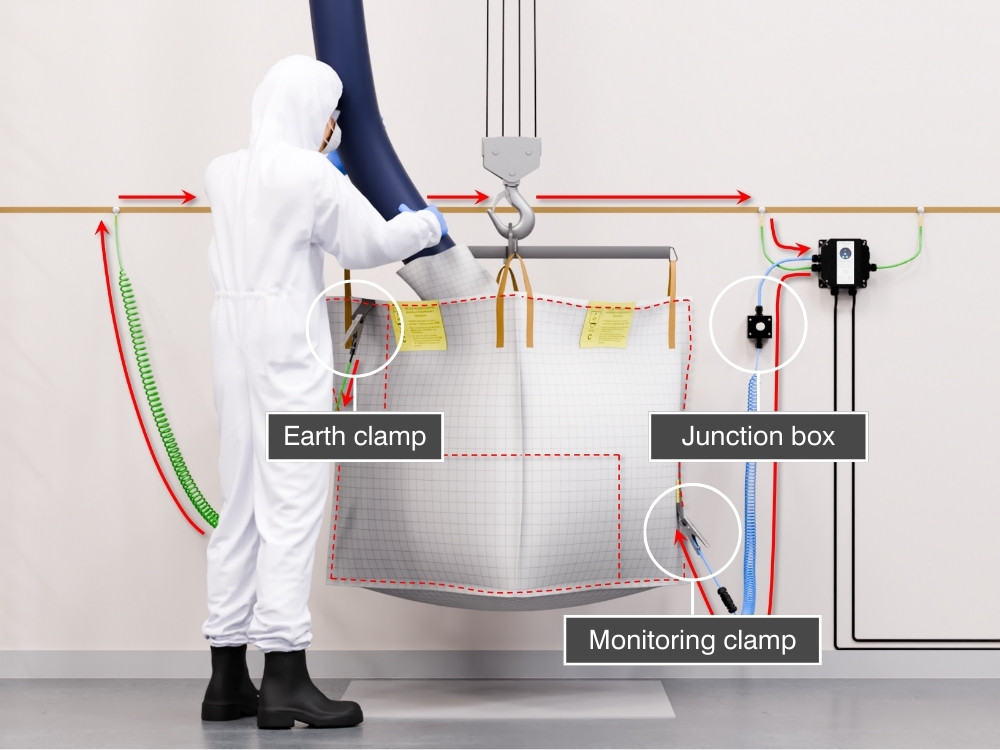
The maximum permissible resistance between the conductive/dissipative parts of the bag to the “designated earth bonding points” of the bag (also referred to as the “groundable point” in the standard) is limited to 1 x 10⁸ Ω. One, or more, designated earth bonding points must be permanently attached to the bag. Bag lifting hooks should not rely on fortuitous metal connections to plant equipment as they may have high resistance protective coatings or product deposits that impedes the dissipation of electrostatic charge from the bag. In addition, physical contact between the hooks and the plant equipment could be intermittent during the loading/unloading process.
The earthing system/device must be connected to the designated earth connection point/s.
It is for this reason that Earth-Rite® FIBC systems are supplied with two earthing clamps as standard.
With respect to liners used in Type C FIBC, there can be no reliance on “fortuitous” connections between the liner(s) and the static dissipative material from which the bag is constructed, emphasising that the connections should be sufficiently strong to withstand the stresses caused by filling, transporting and emptying operations. Clause 5 of the standard outlines the combinations of Type C bags and inner liners that are permissible or not permissible for use in Ex atmospheres.
Attention is also drawn to the potential electrical isolation and electrostatic charging of conductive equipment like tools that could be left on, or near the Type C bag, such that it is difficult to determine if the tool is in good physical/electrical contact with the static dissipative parts of the bag (which should be earthed).
Type C bags and their earth connection points must have labels that enable their identification and correct specification.
As described on the label the standard highlights that repeated cycles of emptying, filling and cleaning, in addition to the potential contamination from other materials, could impair the electrical properties of the bag. It states that after a pre-determined number of cycles (consult the manufacturer) that the bags be tested in line with Clause 9, “Test Procedures” of the standard.
The Earth-Rite® FIBC static earthing system provides a real-time check of the resistance through static dissipative material of the bag, however this does not prove that all elements of the static dissipative material have not been damaged through physical or external material contact.
References to IEC TS 60079-32-1 “Explosive Atmospheres. Part 32-1: Electrostatic hazards, guidance” are made throughout the standard. As stated earlier all aspects of this Technical Specification cannot be listed and should be purchased from an authorised seller. The primary points relating to FIBC are:
- Isolated conductive objects (e.g., tools, bolts, clips, etc.) should not be stored on, attached to, or even temporarily placed on any type of FIBC during filling and emptying operations. Even with Type C FIBC, the rough nature of some FIBC materials may prevent conductive objects placed on the FIBC from contacting the conductive elements in the fabric of the FIBC.
- In hazardous areas, all conductive objects within the immediate vicinity of any FIBC (i.e., less than about 1 m away) should be properly earthed during filling and emptying operations.
Newson Gale are not experts in hazardous area assessments. The advice of an expert in carrying out hazardous areas assessments should be sought whenever there is doubt about the correct course of action in relation to Ex operations.