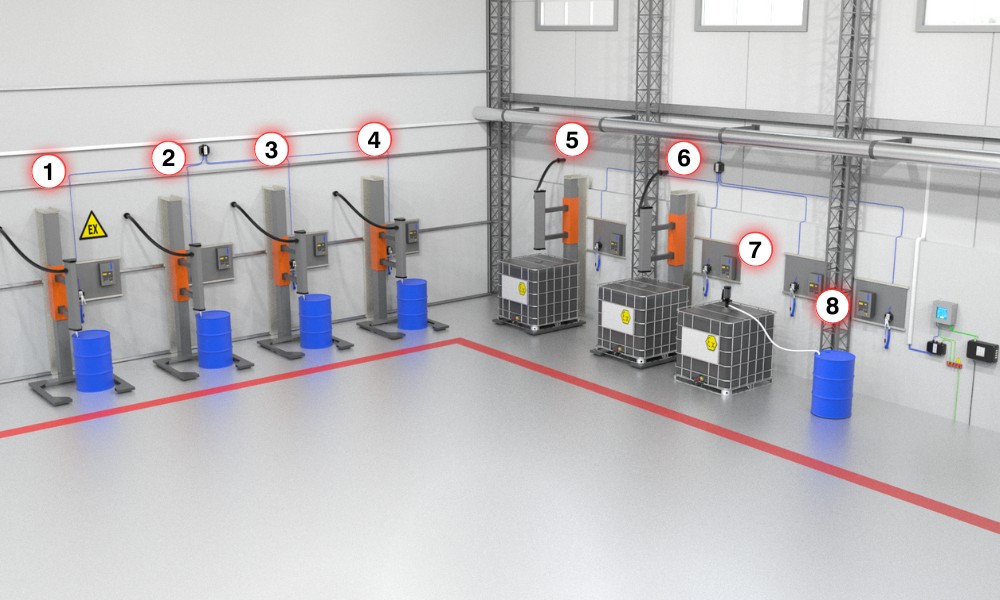


Metal drums and EX IBCs are containers that provide site operators with a flexible means of transporting and processing batch quantities of products. Operations ranging from mixing, agitation and blending to the filling and emptying of low conductivity liquids can result in the generation of static electricity, leading to the accumulation of electrostatic charge on the container if it is not earthed. If electrostatic charge is permitted to accumulate on the container, the risk of an incendive static spark discharge to objects at a different potential, like operators and other plant equipment, is a high possibility. If a flammable atmosphere is present at the static spark discharge location, then ignition is very possible.
The processes associated with metal drums and EX IBCs in the 205 litre to 1000 litre range normally rely on the use of pumping or mixing equipment. Site operators have the option of specifying active earthing systems that feature output contacts that can be interlocked with the process equipment*. In this scenario, the mixing or pumping process cannot take place unless the earthing system confirms that the metal drum or EX IBC has a connection to the site’s designated earth with a resistance of 10 ohms or less.
* Assumes the earthing system is installed as per the accompanying Instruction Manual.


The range of materials that make up the construction of IBCs and drums needs to be assessed by site operators when trying to mitigate the risk associated with static electricity.
The use of plastic, a naturally low conductivity material, whether it be used as a vessel for IBCs, or as a liner inside metal drums, is a factor that needs to be considered. The use of static dissipative plastics has also increased over the last 10 to 15 years. As such, there is a multitude of “composite” drums and IBCs being used in EX atmospheres today.
Wherever possible, Newson Gale adopts guidance on electrostatic hazards from standards publishing institutions and industry bodies that can help define the parameters for effective earthing and bonding in EX atmospheres.
As Newson Gale is not a static control consultancy, we cannot recommend any specific types of containers for different processing applications, but if IBCs with plastic containers are a process requirement (e.g., for material compatibility reasons), please consult Section 7.3.4 of IEC TS 60079-32-1 alongside an on-site risk assessment. Wherever possible, the use of low-conductivity plastic should be avoided.
ESIG, the European Solvents Industry Group, has a free downloadable guide for site operators engaged in the processing and transportation of solvents.
This document provides practical guidance on the different types of IBCs and drums in use within the solvents industry.
If you require a static control solution for metal drums or IBCs that are of a static dissipative construction, please contact us for solutions that can actively monitor at resistance thresholds higher than 10 ohms.